As the energy industry’s leading independent O&M service provider for more than 40 years, NAES is once again on the front lines of innovation. The company assumed care, custody, and control of the ACES Delta hydrogen project in Delta, Utah. This first-of-its-kind facility moves green hydrogen from concept to large-scale industrial reality, providing a complete end-to-end solution to produce, store, and supply renewable hydrogen to support year-round power for the western United States.
“It’s overall a new technology that is the first in NAES’s fleet,” O&M Transition Services Manager Mike Adams, who has helped guide the project, said. “It’s one of the only locations in the United States and one of only a couple in the world where this technology is feasible.” He also sees ACES as a pivotal move toward a more resilient generation mix. “This is a big step in NAES’s overall operations portfolio. I think it’s a very big deal.”
The project is first-of-its-kind because of its scale and timing. “Scale is a defining feature of this project,” Senior Operations Director Jim McConville said. “It’s the largest of its kind in the United States and will be among the first to move into full commercial operation.” This project also puts NAES in a highly competitive position. “From an operations standpoint, this is a new and exciting space for us,” Jim added. “While NAES has not previously worked directly with electrolyzer technology, the process itself is relatively straightforward, just using direct current to separate water molecules into Hydrogen and Oxygen.” While the technology is new to NAES, the project ultimately relies on the same disciplined operations and maintenance the company brings to every plant. “At the end of the day, we are still taking in renewable energy and using it within a process to generate output.”
How it works: Technology of the ACES Project
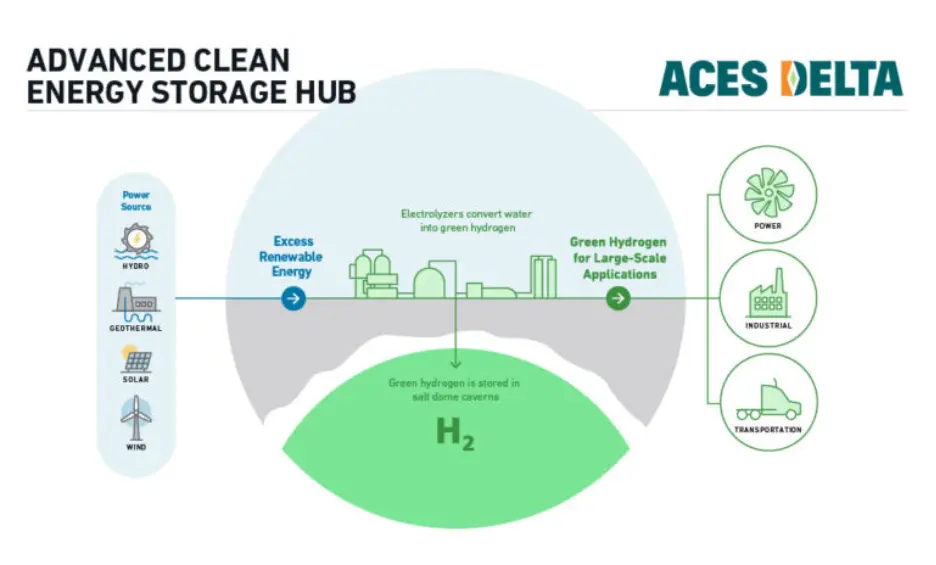
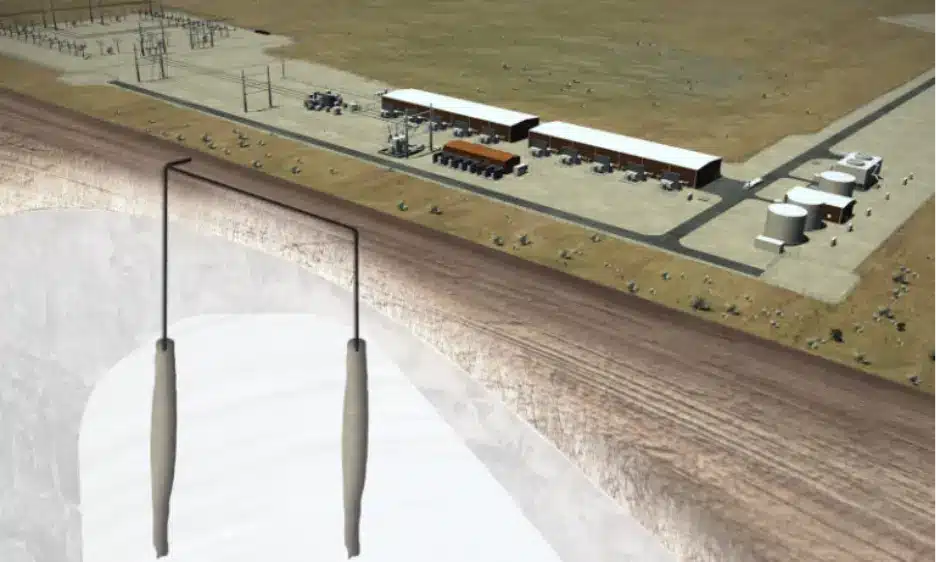
The Advanced Clean Energy Storage Site (ACES) is built adjacent to the site of a retiring coal facility. It converts excess renewable energy on the western interconnect into green hydrogen, stores it in massive underground salt caverns, and delivers that to fuel an 840-MW hydrogen-capable gas turbine plant across the road. The project brings together large-scale electrolysis, cavern storage, and hydrogen-capable power generation into a single, integrated system. Together, these components enable the production, storage, and delivery of green hydrogen, which can be used to generate power. While NAES supports key elements of the project, it does not operate the power generation facility.
Converting Green Hydrogen:
During off-peak hours, ACES captures surplus wind and solar power to run its electrolyzers, converting water molecules into green hydrogen and oxygen. The facility is designed to convert over 220 MW of renewable energy and can produce up to 100 metric tonnes of green hydrogen per day. ACES represents one of the world’s largest orders for electrolysis equipment and will nearly double the global installed capacity for electrolysis upon full operation.
Storing Green Hydrogen:
The hydrogen is then stored in two massive subterranean salt caverns each with a working capacity of 5,500 metric tonnes, which provides a combined storage capacity of more than 300 GWh of dispatchable energy at startup.
Plant Manager Kent Heap describes the caverns as a “molecular battery.” Unlike conventional batteries that are designed for hours of storage, this system can bank renewable energy produced in the spring, when the demand is low, and dispatch it during the summer or winter, when the demand peaks.
To appreciate the scale of the storage capability, consider that it would take more than 40,000 shipping containers of lithium-ion batteries to match the megawatt-hours of energy that a single hydrogen salt cavern can store. Just one of the ACES salt caverns has the capacity to store the entire state of California’s monthly curtailed energy. “This fundamentally redefines what large-scale energy storage can look like,” Heap added.
Delivering Green Hydrogen:
ACES central Utah location makes it the best place to utilize this technology, because it can seamlessly integrate with the Western power grid. According to the project’s website, ACES will serve as a green hydrogen gas and storage site for the Western United States. It will deliver green hydrogen for the power generation, industrial, and transportation sectors.
Generating Power from Green Hydrogen:
As mentioned above, the stored hydrogen will be used to fuel an 840-MW hydrogen-capable gas turbine combined-cycle plant across the road. The plant will run on a blend of green hydrogen and natural gas and will incrementally expand to 100% green hydrogen by 2045, according to the project site.
Reshaping what it means to operate a NAES facility
The process is reshaping what it means to be a NAES operator. Many members of the technical staff at the ACES Project came from coal and independent power producer backgrounds. They bring deep experience in systems, instrumentation, water treatment, and cooling. “The skillsets developed in traditional coal and gas plants translate to the green sector,” Jim noted. “While the product changed from electricity to hydrogen here, the core knowledge of systems and instrumentation remains the same.”
For ACES Plant Manager Kent Heap, the project is both technically unprecedented and operationally demanding. “This is a first-of-a-kind mass electrolyzer production facility with large-scale underground hydrogen storage,” he said. “The equipment we operate and maintain
is a hybrid between two types of facilities, somewhere between a refinery and a power plant.”
That unique profile requires a workforce drawn from power generation, oil and gas, and cryogenic processing backgrounds, with a strong emphasis on operations and maintenance. A particular focus is placed on instrumentation and electrical systems, given their critical role in process control, safety, and continuous plant performance.
The project is permanently staffed with approximately 20 NAES employees, supported by additional short-term specialists during turnover and commissioning activities. The team has successfully navigated several years of complex commissioning work and shifting schedules.
Mike described the group as exceptional: “It’s probably one of the better crews I’ve ever worked with. I would take them on all our projects. They’ve been working through a lot of challenges for a long time and consistently get the job done.”
NAES Safety: A Blueprint at ACES Delta
Hydrogen is a hazardous material, but at ACES it is managed through multiple layers of engineered safeguards and disciplined operations rather than treated as uncontrollable or inherently unstable. Safety Instrumented Systems (SIS) and advanced process control systems are in place to continuously monitor conditions and automatically respond to abnormal situations, helping ensure safe operation of the facility.
A critical part of maintaining that safety barrier is the ongoing calibration and verification of instrumentation across the plant. These routine checks ensure that sensors and control devices remain accurate and reliable, directly supporting both operational integrity and personnel safety.
Safety is the non-negotiable foundation of everything the NAES team does. ACES operates as a Process Safety Management (PSM) facility, and every employee and supervisor has completed hydrogen-specific safety certification, including a dedicated 20-hour training course focused on safe hydrogen handling.
As Jim McConville noted, “There is a heightened emphasis on safety here. Because of hydrogen’s properties such as its wide flammability range and fire and explosion potential, the level of checks and reviews is significantly higher than at a typical plant. Every process goes through deeper scrutiny.”
Because nothing like ACES existed before at this scale, the team had to build its own qualification and training programs for mechanics, IC&E techs, and operators. NAES partnered with Black & Veatch, Overland, Mitsubishi, and the Center for Hydrogen Safety to get it right. Through this process, the team designed tools and procedures to be spark-resistant and ensured that every system start-up went through a formal pre-startup safety review.
Success at ACES begins with an uncompromising safety record: zero serious injuries and full compliance with SIS and SIL requirements under the Process Safety Management (PSM) program.
“Due to the sheer volume of hydrogen we generate and store on site, our Process Safety Management (PSM) program operates with a level of complexity and scrutiny that is not typical of conventional power generation,” Kent said. “Every element of it is driven by the product: hydrogen.”
Achieving and sustaining this standard requires a high level of rigor, attention to detail, and disciplined planning to reinforce NAES’s long-standing commitment that safety is the first and most important value for every employee at the site.
Once that safety foundation is firmly established, success is then measured in operational terms such as sustained hydrogen production and reliable delivery to off takers.
As NAES moves into full care, custody, and control of the ACES Delta project, it becomes a blueprint for future renewable energy sites. NAES is proving that traditional O&M discipline, applied to new technology, can turn hydrogen from a promising concept into dependable infrastructure for utilities and investors, and a long-term career platform for the workforce that will operate it. “Being part of the pioneer team that is operating one of the first fully integrated green hydrogen hubs at this scale is exciting,” Jim said.