By Jim Forehand, CMRP
Director – Risk and Reliability
For years, I watched facilities treat electrical equipment maintenance as a recommended best practice. It was important work, but it was often managed through a patchwork of OEM guidance, site experience, preventive maintenance templates, and accumulated CMMS entries.
The 2023 edition of NFPA 70B changed that.
NFPA 70B has moved from a recommended practice to the Standard for Electrical Equipment Maintenance. That shift requires owners, operators, and managers to adopt a far more structured approach. Facilities are now expected to run a documented, risk-based Electrical Maintenance Program that identifies equipment, assigns maintenance requirements, defines intervals, trains personnel, documents work, and conducts annual reviews. This is not solely an electrical issue. It touches safety, reliability, compliance readiness, and asset risk.
NFPA 70B and NFPA 70E Have to Work Together
Most professionals know NFPA 70E, which addresses workplace electrical safety and worker qualification. NFPA 70B is different. It focuses on the condition of the equipment being serviced, and that distinction matters. A qualified electrical worker cannot safely operate equipment that has not been properly maintained. Worker qualification and equipment condition are interdependent. NFPA 70E protects the worker; NFPA 70B ensures the equipment is maintained so no one is exposed to degraded or undocumented assets. Bridging that gap is now essential.
Why This Went Under the Radar
The biggest challenge with NFPA 70B is awareness. Many companies do not know the change occurred, and others have not figured out how to implement the standard at the plant level.
I understand why. Maintenance managers already carry full workloads. Plant managers balance safety, availability, outage planning, budgets, staffing, compliance, and owner expectations. Asset managers focus on risk, insurance, capital exposure, and long-term value. When the task of building a compliant program lands, the first reaction is usually that it represents a significant workload.
It is not a short-term project. Facilities must develop or align their program, inventory equipment, assess existing CMMS data, identify gaps, prioritize assets, define tasks, set intervals, coordinate training, and establish governance to keep the program current. The CMMS is a useful starting point, but it is often incomplete. Many electrical assets, particularly breakers and distribution components, are not represented in enough detail to support a full program. That does not mean starting from scratch. It means reconciling the existing maintenance system with the actual electrical asset base.
The Reliability Case Is as Strong as the Compliance Case
Compliance gets the attention, but reliability often makes the more immediate business case. Electrical failures are not minor events in a power plant. A breaker failure, transformer issue, switchgear problem, degraded cable termination, failed protective device, or missed thermal anomaly can trigger forced outages, safety exposure, equipment damage, and extended recovery time.
The numbers support this. Industry data indicates that 15–25% of reliability events are caused by electrical issues. A NAES review of one 2×1 combined-cycle plant’s 2023–2025 GADS data found that 24% of GADS events were electrical in origin.
For that reason, I view NFPA 70B as more than a documentation exercise. Implemented correctly, it functions as a reliability strategy and prompts the right questions:
- What electrical equipment do we have, and which assets are critical to generation, safety, and recovery?
- What condition are they in, and is the operating environment consistent with their design?
- What do the OEM, NFPA 70B guidance, and our own history tell us about intervals?
- Are thermography results telling us to adjust frequency, and are corrective actions being captured and closed?
These are reliability questions, and NFPA 70B provides a standardized framework for answering them.
Insurance and Owner Expectations Will Drive Adoption
Owners and operators should also recognize the financial exposure. Not every NFPA 70B discussion will begin with a regulator. OSHA may become involved after an incident, particularly around worker protection and the link between NFPA 70E and equipment condition. But near-term pressure is more likely to come from clients and insurance carriers.
Carriers will ask practical questions. What equipment have you identified? Which assets are critical? Where is your maintenance program? How do you know the equipment is being maintained? Are tasks documented, intervals justified, and records available? Are deficiencies corrected?
If a facility experiences an electrical loss and cannot demonstrate an appropriate program, defending its position becomes difficult. For owners, the issue is not just task completion. It is whether a documented, risk-based program exists to show how tasks were selected, scheduled, performed, and reviewed.
What Implementation Looks Like
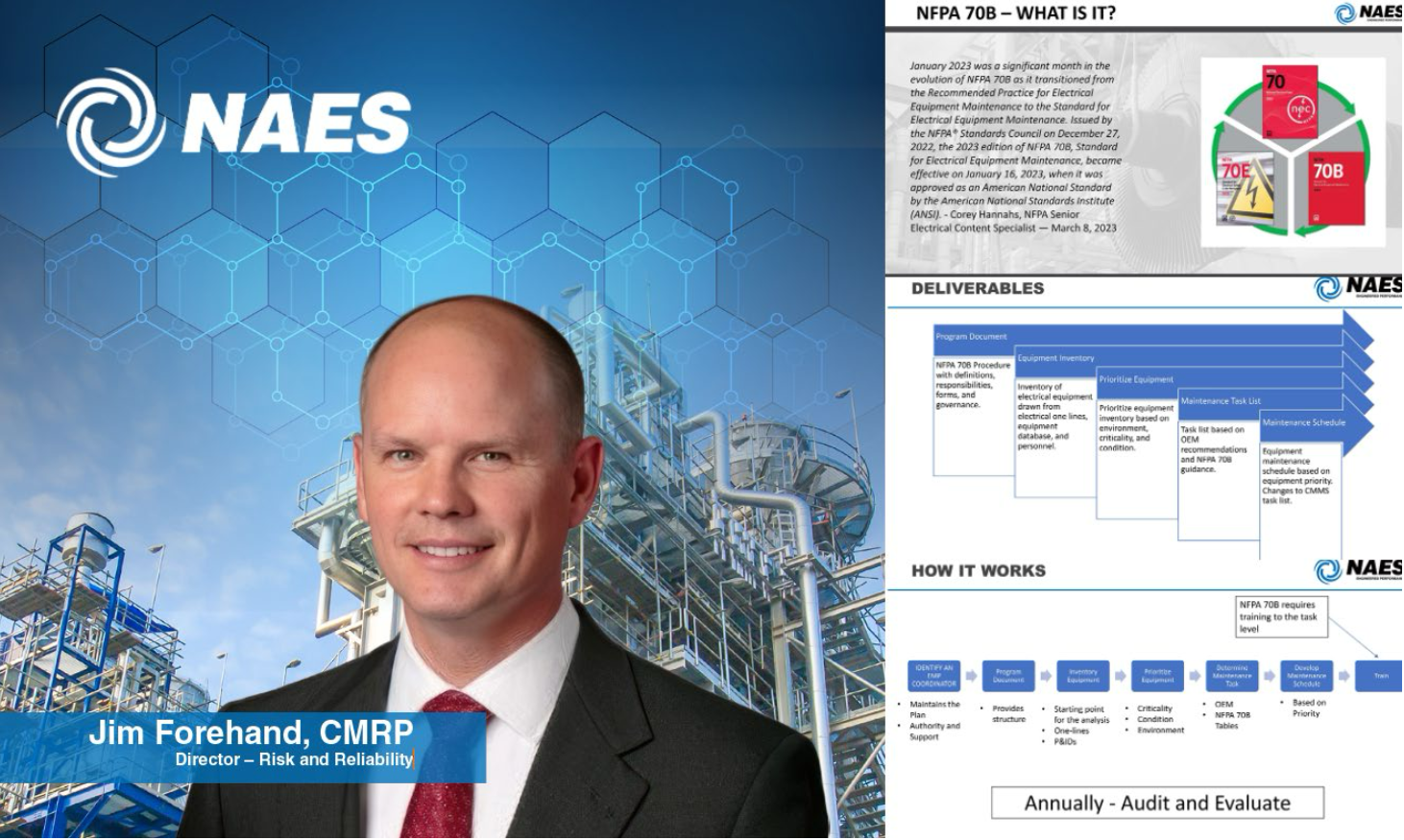
A practical implementation starts with structure. The facility should appoint an Electrical Maintenance Program coordinator with appropriate authority and support. That person will not perform every task, but clear ownership is essential. Without it, the program drifts.
From there, the work follows a logical sequence:
- Create the program document. Define responsibilities, governance, forms, expectations, and boundaries, including which tasks site personnel perform, which are contracted, and how records are controlled.
- Build the equipment inventory. Use one-lines, P&IDs, equipment databases, field verification, and site knowledge. Equipment you cannot identify cannot be prioritized or maintained.
- Prioritize the equipment. Because the standard is risk-based, weigh criticality, condition, environment, duty, operational consequences, safety exposure, and history.
- Determine maintenance tasks. Integrate OEM recommendations, NFPA 70B tables, site experience, and equipment condition to define the right work at the right intervals.
- Develop the schedule. Enter tasks into the CMMS, align them with outages or operating windows, and assign qualified personnel or contractors.
- Provide task-level training. Track who performs each task, their qualifications, and how those qualifications are documented.
- Audit and evaluate annually. When thermography reports, failures, corrective actions, environmental changes, or equipment modifications point to a need, revise the program.
The Heavy Lift Is the Site-Level Detail, Not the Procedure
Writing a procedure is not the hard part. The hard part is turning that procedure into a plant-level program that reflects the actual facility. A program document may take 40 to 80 hours. The inventory, prioritization, task development, and scheduling effort can be far larger. For a typical 2×1 combined-cycle plant, the estimated support includes 160 hours for equipment inventory, 120 hours for prioritization, 320 hours for task and schedule development, and 40 hours for annual review. This work is not turnkey, and it requires craft involvement.
That involvement is critical. The people who operate and maintain the plant know where the drawings are wrong, where equipment has been modified, where access is difficult, and where the CMMS does not tell the whole story. A strong program cannot be built from a conference room alone. It has to be built from documents, data, and field reality.
The Best Programs Use What Already Exists
Most plants are not starting from zero. They already have preventive maintenance, inspection practices, thermography, testing, outage work, OEM manuals, electrical drawings, and maintenance history. The opportunity is to consolidate that information into a governed program that meets the standard’s intent. That means leveraging the CMMS, improving asset hierarchy where needed, linking tasks to actual equipment, documenting interval selection, using corrective action data to strengthen the program, and making the annual review meaningful.
At NAES, this fits how we already think about operations and maintenance: reliability, compliance, safety, and cost must be managed together. Our O&M approach emphasizes customized programs built around predictive and preventive solutions, trained and qualified people, effective processes, high performance, and continuous improvement. That is exactly the mindset NFPA 70B requires.
What Plant and Asset Leaders Should Do Now
I recommend four practical steps:
- Assign ownership. Identify who will coordinate the program, and make sure that role has support.
- Assess the current state. Review your equipment inventory, one-lines, CMMS hierarchy, existing PMs, thermography program, testing records, OEM manuals, and contractor scopes.
- Identify gaps. Determine what equipment is missing, where tasks are undefined, where intervals are unjustified, where training documentation is incomplete, and where records are hard to retrieve.
- Budget realistically. A credible implementation takes time. Simple-cycle facilities require less effort than combined-cycle or more complex plants. Plan the work, resource it, and integrate it into outage schedules.
The key is to begin promptly. Waiting for an event, audit, insurance request, or owner inquiry to force action is not a strategy.
NFPA 70B Is a Standard, but the Value Is Operational
Plants that implement NFPA 70B well will use it to improve how electrical equipment is identified, prioritized, maintained, and reviewed, rather than treating it as paperwork. That is where the real value lives. A well-built Electrical Maintenance Program supports safer work, stronger reliability, better audit readiness, improved maintenance discipline, and more defensible asset management. It gives the owner and operator a clear answer when someone asks, “How do you know this equipment is being maintained?”
For me, that is the point. NFPA 70B is not simply about meeting a standard. It is about managing the electrical systems that support plant safety and production with the same rigor we expect from the rest of the facility. Electrical equipment does not fail on the CMMS schedule. It fails because of condition, environment, duty cycle, age, and maintenance practices. NFPA 70B gives us a framework to manage those variables before they become safety incidents, forced outages, or financial losses.
And that is work worth doing.