
As the world races to expand firm, dispatchable thermal generation to meet the extraordinary electricity requirements of AI and data-center infrastructure, the Engineering, Procurement, and Construction Management (EPCm) model has become an attractive and necessary alternative to conventional EPC contracting. EPCm provides owners & developers with control over procurement, competitive contracting, and risk allocation by contracting an EPCm contractor that integrates engineering, supports procurement, and manages construction execution on the owner’s behalf. This model contrasts with lump-sum EPC, where the contractor assumes the majority of project risk and design flexibility is constrained once contracts are executed.
On the front end, it is vital for owners to manage the timelines around engineering and procurement is key and owners waiting for an EPC contract to be executed to complete both of these critical items could be very damaging.
The advantages for new build power plant developers are significant. With procurement executed on the owner’s paper, unused contingencies can translate directly into capital cost savings. EPCm also enables a disaggregated packaging contracting strategy that increases competition, strengthens contractor accountability, and offers greater flexibility when managing scope changes—critical in large-scale thermal projects where equipment lead times, regulatory variables, and supply-chain dynamics must be actively managed. Enhanced early-stage scope development and tighter lifecycle integration further support schedule compression and risk reduction, improvements supported by industry analysis.
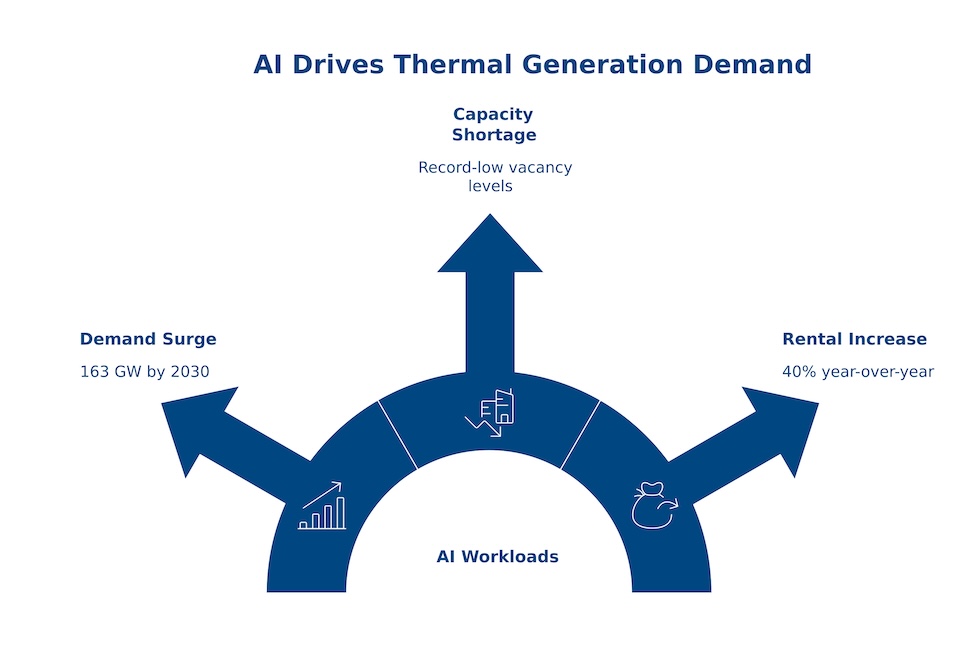
AI-driven electricity demand is accelerating the need for thermal generation faster than EPC capacity can be mobilized. Bain & Company forecasts global data-center power demand reaching 163 GW by 2030, nearly double today’s levels, with U.S. data-center electricity consumption potentially rising to 409 TWh—most of it attributed to AI workloads. Major U.S. markets such as Northern Virginia and Dallas are already operating at record-low vacancy levels, with Northern Virginia falling to 0.9% vacancy and year-over-year rental rates rising more than 40% due to capacity shortages. These constraints reinforce the need for rapid development of new thermal assets and highlight why owner-controlled EPCm models —faster to deploy, more flexible, and more competitive—are becoming the preferred delivery pathway.
At the same time, the pipeline of available EPC contractors is shrinking relative to project demand. Traditional EPC providers are heavily committed across gas, nuclear, renewables, and grid-expansion portfolios. Globally, the challenge is no less significant. Power systems in every major region are grappling with surging electricity demand, constrained transmission infrastructure, and the need for reliable firm generation to balance renewables. Thermal capacity additions remain central to stabilizing grids worldwide, and EPCm models—offering flexible packaging, strong engineering integration, and comprehensive lifecycle management—are increasingly used to deliver complex, large-scale generation assets under these demanding conditions.
EPCm offers owners and developers the flexibility, cost efficiency, and schedule certainty required to deliver the next wave of thermal power assets that will underpin North America’s AI-driven energy future. NAES Project Services stands uniquely equipped to support this shift—providing structured project management, global execution frameworks, risk-tracked scheduling, commissioning oversight, field-staffing solutions, and performance-based delivery models backed by our Project Management office using advanced digital project-controls platforms.
We invite developers, utilities, and investors to partner with us to accelerate their thermal generation programs with a proven EPCm leader capable of delivering results across both North America and globally.