By John Schmoker, Compliance Testing Services Project Manager
HIGHLIGHTS
- The annual Summer Reliability Assessment (SRA) evaluates resource adequacy to meet projected peak demand and identifies potential reliability issues and region-specific risks.
- Key risks include:
- Rising demand forecasts
- Unpredictability of large loads
- Rate of change of resource mix
- Drought conditions
- All regions should have adequate resources for normal summer peak load.
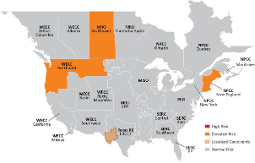
- WECC, NPCC-New England, and MRO (SaskPower) are at elevated risk under more severe loading conditions.
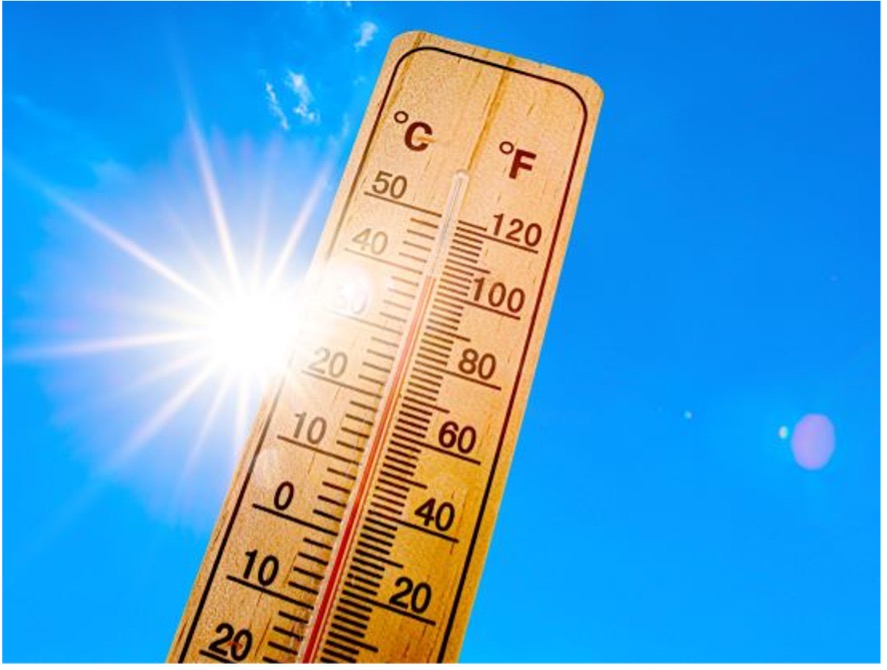
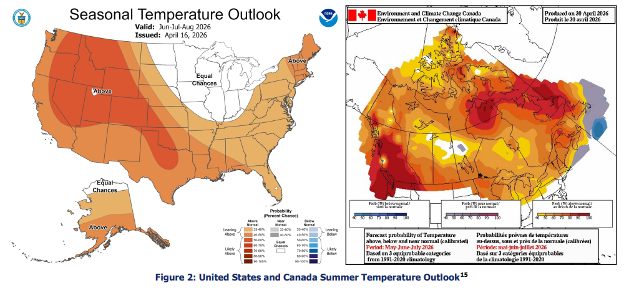
- The National Oceanic and Atmospheric Administration (NOAH) forecasts above-normal temperatures and below-normal precipitation for summer 2026.
- A large influx of new generation is boosting reserves and improving the overall reliability outlook.
- Early high temperatures have caused issues with normal spring outage schedules, calling for another look at shoulder season supply-demand analyses.
- Increased battery storage capacity is helping bridge the gap between conventional and IBR generation resources.
- IBR performance remains a concern for grid operators relying on those resources to meet increasing demand.
- Large computational loads pose operational and planning challenges.
“The 2026 Summer risk profile is marked by rising demand, significant generation growth in many areas, the prospect of challenging hydrological conditions, and the unpredictability of large loads, from both a forecasting and operational perspective. Multiple assessment areas have revised load forecasts downward from mid-2025 projections to account for the observed rate of completion for large load interconnections and the slower-than-expected pace at which some of those loads are coming online. Still, aggregated peak demand across all assessment areas has increased by over 11 GW from Summer 2025 projections that were set earlier in 2025. That level of growth exceeds the year-on-year rise of 10 GW that preceded Summer 2025.” – 2026 SRA
IMPACTS AND RECOMMENDED ACTIONS
The 2026 Summer Reliability Assessment indicates a relatively low-risk summer season, which is a welcome respite from the seemingly endless risks to the BPS. However, NERC has provided the following recommendations as we approach this year’s hottest months:
- RCs, BAs, and TOPs in the elevated risk areas identified in the key findings should take the following actions:Review seasonal operating plans and protocols for communicating and resolving potential supply shortfalls in anticipation of potentially extreme demand levels.
- Consider the potential for higher-than-anticipated forced generator outage rates in operating plans due to plant age, operating patterns, or limited pre-seasonal maintenance availability.
- Employ conservative generation and transmission outage coordination procedures and operate conservatively commensurate with long-range weather forecasts to ensure adequate resource availability.
- Engage state or provincial regulators and policymakers to prepare for the efficient implementation of demand-side management mechanisms called for in operating plans.
- Review outage coordination processes and consider if adjustments are needed to account for early-season above-normal temperatures.
- BAs should also consider the following:
- For areas with ample wind resources, proactively plan for low-wind events.
- Consider low water operating conditions for areas with high penetrations of hydro resources.
- Plan for load recustions from large computational loads in response to system conditions.
Discussion
This year’s SRA is more optimistic than previous years, as all regions are predicting adequate resources for typical summer load conditions. However, a few regions, such as WECC, MISO, and NPCC-New England, are at elevated risk under more severe loading conditions. The primary risk factors have changed slightly from last year, with NERC citing increased demand, drought conditions, and uncertainty around large computational loads as the primary concerns.
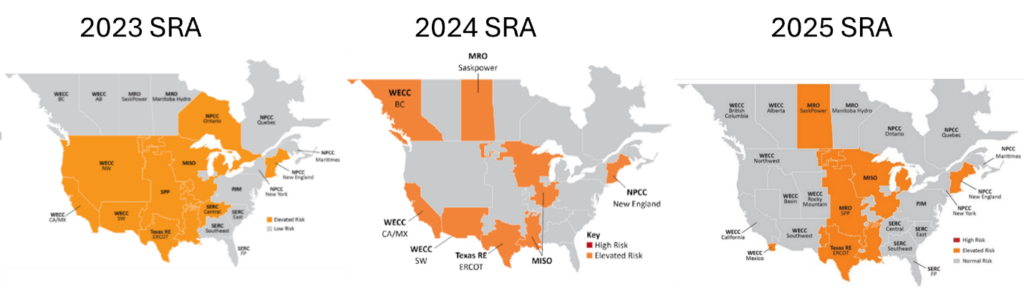
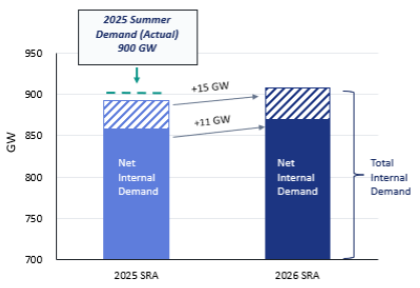
Compared with the last three years, the overall trend looks promising with new generation outpacing demand for the first time in recent memory. While the load profile seems less severe than anticipated, demand continues to expand. According to the latest data, the year-on-year increase in peak demand for Summer 2025 was 10 GW— more than double the increase in peak demand from 2023 to 2024.
Many are looking to Inverter-Based Resources (IBRs) to fill the gap, but even with the rapid adoption of the technology, new installations are struggling to keep pace with the retirements of conventional units. Furthermore, NERC cites rapid changes to the resource mix and IBR performance as additional risk factors, making IBRs look less like an ace up the sleeve.
To make matters worse, NOAA is predicting another hot and dry summer for most of the country. Fire danger in the Northwest is a particular concern with below-average precipitation expected for the region.
Despite evolving risk patterns, NERC’s recommendations in this year’s SRA remain largely unchanged from last year – look as far out as practical, operate conservatively, and expect performance issues regardless of generator technology.
Links and Resources