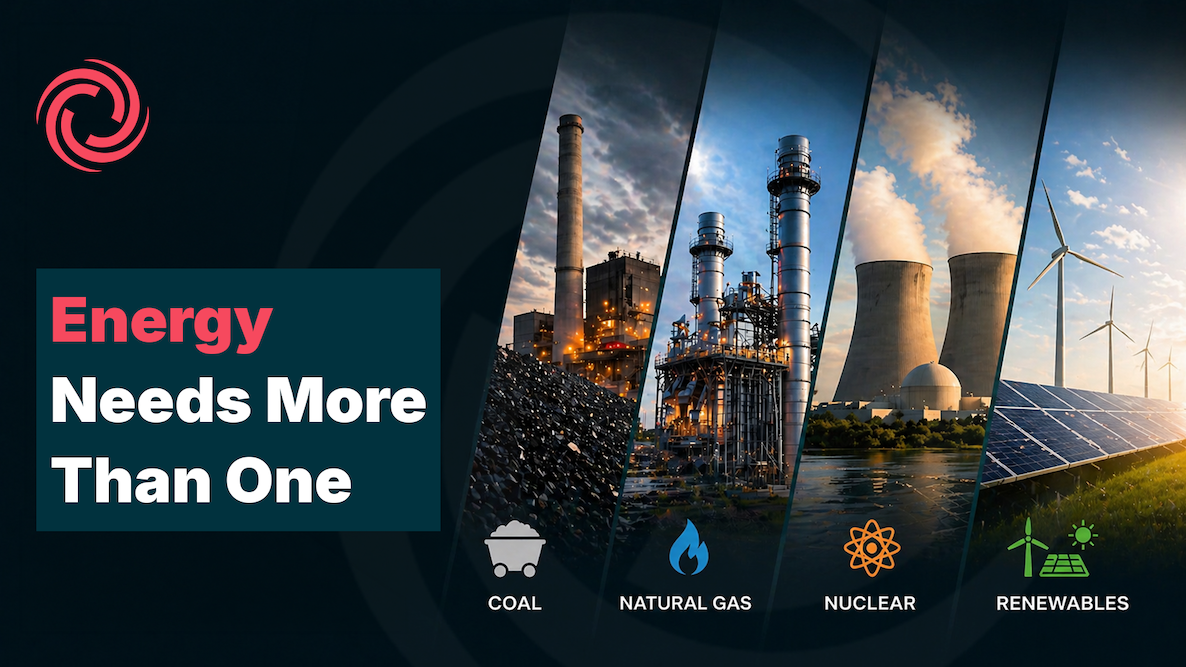
Listen to most public conversations about the energy transition, and you hear a simple question: which technology should win—gas, coal, renewables, or nuclear?
The grid we rely on today was built over more than a hundred years of engineering, policy, and market decisions. We can’t just start over. We’re working with coal plants from the 1970s, gas units designed for baseload that now cycle every day, wind and solar projects waiting in crowded interconnection queues, and nuclear plants licensed to run for up to 80 years.
The real question is: how do you operate all of it—safely, reliably, and profitably—while the system is being rebuilt under load?
How We Got Here: From Coal Backbone to Gas and Renewables
For roughly half a century, coal was the backbone of U.S. electricity. Large plants in the interior of the country pushed power long distances to growing coastal cities, across transmission corridors mostly built between the 1930s and the 1970s. Many of those lines are still in service today.
Over time, environmental rules tightened and new technologies emerged. The fracking revolution unlocked large volumes of low-cost natural gas and reshaped fuel economics. Gas-fired combined-cycle and simple-cycle plants offered faster builds, lower emissions, and improved heat rates. At the same time, wind and solar technologies began to mature, and their installation and operating costs fell sharply.
None of this happened in isolation. Market rules, federal policy, and state-level mandates all pushed in the same direction: a more diverse mix of resources, and a much more dynamic operating environment.
Coal: Managing the Last Miles Safely
Coal remains on the system in many regions for one simple reason: reliability.
Coal plants provide inertia, voltage support, and long-duration energy during extended cold snaps or periods of low renewable output. Yet the aging profile of these plants is hard to ignore. Many were built in the 1960s through 1980s, and operators now face a combination of material degradation, environmental compliance pressure, and shrinking OEM and labor support.
The operating challenge has shifted. Instead of “run full and forever,” the mandate is to run safely, predictably, and transparently to the last day of operation. That demands disciplined outage planning, clear prioritization of capital and maintenance on life-limiting components, and documentation that stands up to lenders, regulators, and potential buyers when retirement or sale comes onto the table.
Gas: The Flexible Workhorse of Today’s Grid
Modern combined-cycle plants deliver high efficiency with lower CO₂ per megawatt-hour than coal. Simple-cycle peakers provide fast-ramping capacity that complements variable renewables. Cheap, widely available gas made these plants the default choice for new build from the late 1990s onward.
But the operating profile many plants face today is very different from what their designers imagined. Units built for baseload or limited cycling now start, stop, and ramp multiple times a day. Capacity markets, ancillary service products, and congestion pricing change dispatch patterns in ways early pro formas didn’t predict.
In that environment, O&M discipline translates directly into avoided cost and preserved bankability. Operators have to balance wear and revenue with carefully managed start sequences and ramp rates, align outage strategy with real duty cycles, and use CMMS and performance data to make fact-based decisions about component life and risk. NAES’s gas fleet experience sits squarely in that space: taking assets designed for one world and making them work in another.
Renewables and Storage: Lowest Marginal Cost, Highest Integration Complexity
Wind and solar are no longer experimental. In many markets, they account for the majority of new capacity additions, with solar often the lowest-cost way to add new megawatts. The limitation is not cost; it is variability. Solar output ramps up in the morning and drops sharply in the late afternoon. Wind can swing dramatically with weather systems.
Storage is changing that equation. In high-penetration markets like California and Texas, solar plus storage is becoming the default new-build configuration, shifting midday overgeneration into the evening peak and smoothing some of the most challenging ramps.
Operationally, renewables and storage come with a different set of demands. Instead of a handful of very large machines, owners contend with hundreds or thousands of inverters, trackers, or turbine components, each capable of eroding performance in small increments. Remote operations centers, strong SCADA and data analytics, and clear processes for field response become just as critical as traditional maintenance practices.
For NAES, which has more than two decades of wind experience and a growing portfolio of solar and storage, the focus is on bringing the same rigor, transparency, and bankability to renewables that the industry expects from conventional fleets.